Tuesday, 28 December 2021

Digital diversity

I spent some time pondering the theme, 'freedom to participate', in relation to a possible logo design. In thinking around this theme, I felt that it had more of a connection to the physical world and less the digital world. So for now, I've parked this one. 

Another theme I had identified is 'digital diversity'. Maybe that will generate some better ideas.

Training

In preparation for starting my new job next week, I completed a short course that covered web accessibility. Most of it was stuff I already know, particularly the different types of assistive technology and the Web Content Accessibility Guidelines (WCAG). What I found really interesting, was the first module, about how people access online content. It showed lots of videos of people actually using their assistive technology. They talked through the methods they use, what works well and where they face barriers.

POUR

WCAG is divided into four main sections:

  • Perceivable
  • Operable
  • Understandable
  • Robust.

I find these easy to remember using the acronym POUR.

In each of these sections, there is a wealth of diversity. So over the next few posts, I'm going to think a little about each one and explore some ideas around digital diversity.

Thursday, 16 December 2021

Freedom to do a job

I've spent a lot of time this week, producing training materials to help my client and my team to ensure that their content is accessible once I'm gone. I am so excited about my new job but I'm also sad to be leaving SSCL. Just yesterday, I had a calendar invitation for a meeting on 4th Jan (after I've left) where they want me to review plans for an office renovation and input on accessibility. I declined the invitation and explained why. Then they asked the inevitable question... who will do this kind of thing once I leave? 

Rewind the clocks

I'm going back three years. I started this new job and my dream was to produce amazing eLearning, learn design skills and become skilled in using Storyline (software). 

What has stuck in my mind though, is the first email I got from a learner at the client organisation. They were trying to access a piece of eLearning with their assistive technology, JAWS. They had to complete this eLearning by a particular date but it wasn't built in such a way that it would read with JAWS. That was the beginning of a journey into the lives of real people, people like me, people who just wanted the freedom to do a job.

Barriers

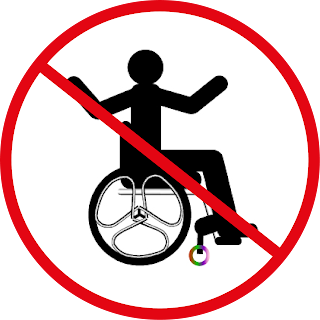
I face physical barriers every day. Most of them are not in the workplace. Most of them are not deliberate, in that there was no intention to prevent me from doing stuff. However, most of them are avoidable. For me though, they might as well put up this sign:

Red circle with red line though. In the middle is a wheelchair icon.

I remember feeling an overwhelming sense of compassion for the unnamed angry blind man at the other end of the email. My heart broke for him because I understood something of what he was experiencing. 

Freedom to do a job

In theory, disabled people can work. We have the right to work. However, there are many barriers. The barriers have historically been so big that some disabled people have given up trying. It's just too difficult!

I remember meeting many disabled people when I was in adult learning. I remember them struggling to explain to me why they couldn't work because of their disability. They struggled because I was the listener, sitting in a wheelchair, working. I was one of the lucky ones. I had people fighting for my freedom to do a job. But I absolutely understood all the reasons why they felt they couldn't do it. They had seen themselves too many times in the centre of that NO ENTRY sign. 

We have to tear down these barriers. It wouldn't be acceptable to deny access to any other minority group... not in this day and age. It shouldn't be acceptable to deny disabled people access either. We have to fight for the freedom to do a job.

I hope somebody at SSCL steps up to do all these extra accessibility tasks. I hope that one day, they will employ somebody specially to do it. For now though, I have to make this my focus. There are too many people facing no entry signs in life and work. It's not okay. We have to fight for freedom.

Sunday, 12 December 2021

Freedom

I've been following a course (by Gareth David Studios) on logo design. I was applying his methods to a possible logo I might want to create in the future, around online/digital accessibility. In the session I watched today, we were developing themes to work with. I came up with a few, but my current favourite is this one:

Freedom to participate

It's based on the idea that everyone should have a basic human right to participate in all aspects of life without facing barriers or exclusions. 

Sounds like a given, right? Well before I go any further with the idea, I thought I'd explore the concepts of freedom and participation a little further. This might take several days of shortish posts.

Freedom to go for a walk

I'll start with this one because last year, this was one of the basic freedoms that was curtailed due to Covid lockdown. In this country, for my entire life, there has been a basic assumption that anyone can go for a walk whenever they like, with whoever they like, and, within certain boundaries, wherever they like. Then, suddenly, we were only allowed out once a day, alone or with one other person, and various people tried to put time/distance restrictions on this... though they thankfully faded away pretty quickly.

Having any kind of restrictions placed on my freedom to go for a walk felt so intrusive and wrong! But actually, for me and many others, there are already quite a lot of restrictions placed on our ability to go for a walk. 

Again, for now, I'll keep it close and short... a quick dog walk around the cemetery...

Free to walk

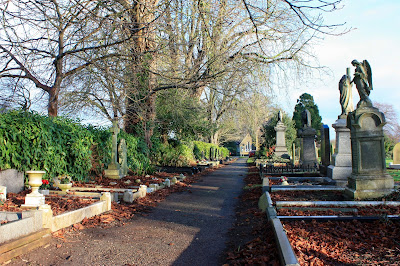
Almost every day, I walk Liggy around the cemetery. It's a pretty place to enjoy peace and quiet and get away from the traffic. The paths are not perfect, but relatively easy to get along in a wheelchair. 

Photo of nice wide path through cemetery with no steps or any kind of barriers.

The cemetery is nice and flat. This adds to my sense of freedom. Going for a walk is relaxing and doesn't feel like a major ordeal. 


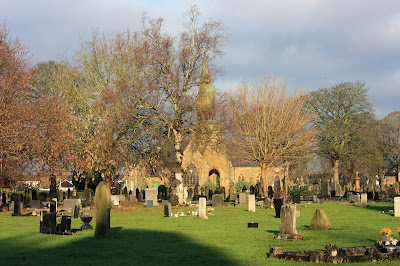
Photo of chapel in cemetery. The ground is level and I was free to take photos of it.

Less free

There are some things that curtail my freedom to enjoy walking my dog...

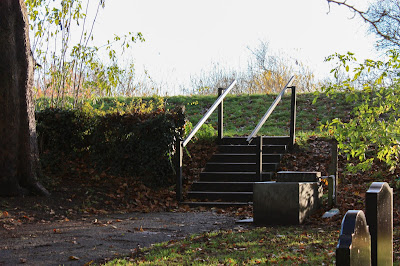
I would love to go up on the river bank and walk along there but most of the entry points have steps... all but one and that one has a grass bank. So that's a pretty big barrier for any wheelchair user.

Photo of flight of steps going from cemetery up to the river bank.

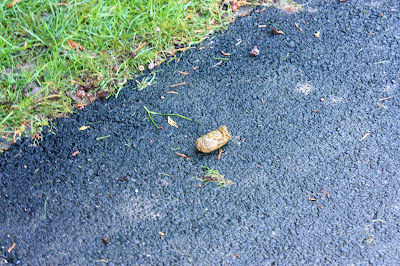
This one is the bane of my life! Today, I spotted it before wheeling through it. Other days, I'm less fortunate. The worst occasion, I wheeled through, got someone else's dog poo all over my wheel, which then spread onto my glove and coat sleeve. The first I realised, I used that hand to push my glasses up my nose. I leave the rest to your imagination. People who don't pick up create a barrier for me. It might not prevent access but it certainly spoils it!

Photo of dog poo that someone has left in the middle of the pavement.

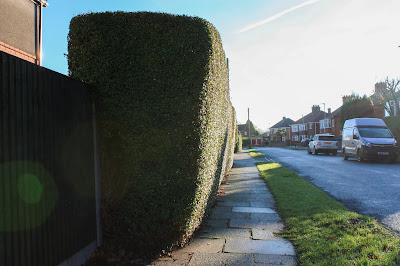
There is just enough room to get Liggy and me along this path because the hedge has recently been trimmed. The owners do this approximately three times a year. At it's worst, I have to go on the grass. Not so bad when it is dry but when wet, my wheels get stuck and very muddy and Liggy (attached to my left side) gets soaked walking through the hedge.

Photo of a neatly trimmed hedge that takes up half the pavement because it has grown too far over.

It's often the little things that make a difference to my freedom to go for a little walk:

  • Bin day
  • Weather
  • Parking
  • Road works
  • State of paving.
The question is, to what extent should we have the right to go for a walk? The next question might be, who should be responsible for removing barriers?

Friday, 3 December 2021

Fighting for rights in a post-Covid era

Firstly, for me, the jury is definitely still out as to whether we are post-Covid. It hasn't gone away. Sure, we have to learn to live with it but that's easy to say for someone like me, who is healthy and particularly has a strong immune system. I have family, friends and general contacts though who are clinically extremely vulnerable... who have been vaccinated but still have no immunity... who are afraid. I can't even imagine what post-Covid means to them.

International day of people with disabilities

IDPWD logo with the full text: international day of people with disabilities.

Today is International Day for People With Disabilities. (I'm sure we could shorten that a little!)

The company I currently work for, SSCL, and its parent company, Sopra Steria, have both been working really hard this year to improve online accessibility. Now that more people are working from home, it has become even more important, as people can't just ask a colleague at the next desk when they get stuck. 

On Wednesday, we held a Lunch and Learn event, in preparation for today. The aim was to show people a few simple things they can do in their daily communications to make content more accessible for all. It covered a range of impairments and the barriers that prevent people with them from accessing content, and we showed how to remove some of those barriers. At the end, we asked everyone to pledge to take action from today and either start or stop doing something. The response was amazing! So many people pledged to add alt text to images... to check the reading order of their PowerPoints... to reduce jargon and speak in plain English. For me, the one I liked best though was: I pledge to start asking people for feedback on the accessibility of my content. This came from an idea related to lorries having a sticker on the back saying, how is my driving? What a fab idea!

A few reminders

So, with no further ado, here are my top five tips for making your normal, daily content accessible:
  • Provide alt text for all images - usually, right-click and then add a description of your image. On social media, this is usually done through an EDIT button when you upload your image.
  • Check colour contrast is sufficient - ideally, start using a free tool such as the WebAIM contrast checker.
  • Give your hyperlinks meaningful text - the text on the page should tell the user what they are going to see. The URL (web address) should be hidden in the background.
  • Check the reading order - this is especially important with things like PowerPoint, where you create content in a random order and then rearrange it on the page. A screenreader doesn't know how it should be read unless you check the reading order. This is often in the Review menu under Check Accessibility.
  • Structure your content correctly - use headings and subheadings so that your content is easy to follow and understand. Don't just change the size and style of the font. Change it in the Styles section of your software.

If you don't know how to do any of the above and want some help, please let me know. I have videos to show how some of these work in practice, but I'm happy to make more and look at different applications if it helps.

Sunday, 14 November 2021

What makes a place accessible?

I rang a pub yesterday to find out whether they are accessible or not. As I asked the question, it occurred to me that it was a somewhat vague question to ask. I mean, what makes a place accessible or inaccessible for me might be different than for other people, even with similar conditions. So here are some thoughts on accessibility of places.

Getting in

For a wheelchair user, getting into the venue is usually the first hurdle. Steps make this pretty much impossible, so some kind of ramp is usually used to give buildings level entry. Ramps vary though. There are the kind of ramps that have actually become part of the fabric of the building... concrete, sensible and compliant slope (1 in 12 or less) and that generally bring you into the main entrance of the building. There are other permanent ramps that are installed somewhere to enable wheelchair users to get in, though maybe not at the same entrance as everyone else. Then there are the temporary/portable ramps, which may or may not have a usable gradient. I've been presented with some that are at a 45o angle and downright impossible to use.

I believe that the vast majority of venues, if they really wanted to, could provide some form of level entry. Many blame listed building status for not providing it but I've been to many historic houses, old buildings and so on, that have managed to adapt their entrance area and allow wheelchair users to get in. 

To be fair though, I have also been to some places, like the church where my son recently got married, where I fail to see how they could provide safe level entry to the grounds. This is usually due to being built into a very steep hill and not having enough space. I have more sympathy when this is the case, rather than just blaming listed building status and the local council.

Of course, there is one option I haven't mentioned... and that is the alternative entrance. This can work well but not if it takes you, e.g. through the bins in a rear yard, then through a busy kitchen with people running around with knives and hot pans, to get you into the restaurant.

Getting into a building shouldn't be stressful, scary, make you feel like an inconvenience or reliant on another person for assistance. 

Getting around

Many people assume that if you can get into the building, that's the job done. Not so! Moving around is also important. This means that the doorways can't be narrower than my wheelchair. I have to physically fit through. It also means not having to negotiate steps once inside. 

Of course, there are ways of making a multilevel building accessible. Lifts are the obvious... either a normal lift or one of those platform lifts that gets you there eventually. Stairlifts are an option too but often don't work for people who use heavy electric wheelchairs or scooters. We were at Castle Howard yesterday and they have a platform stairlift. You wheel on and then it takes you up the stair case just like a normal stairlift. It was painfully slow but it did the job and was probably cheaper and easier to install than a lift (in a listed building). 

Photo of a large staircase in a country house. It is decorated for Christmas. Along the left side of the stairs, is a platform stairlift, carrying a wheelchair user up the stairs.

Once we've dealt with physical barriers such as doors and stairs, other things that make moving around difficult include: 

  • Layout - are tables and chairs blocking the walkways so that you have to keep asking people to move to allow you through? Are the aisles too narrow? Do they have items such as temporary promotions blocking them?
  • Flooring - thick pile carpet is really hard work to wheel on, rather like wading through knee-deep treacle! Uneven flooring and things like cables and hoses can also make it difficult. My dream is nice smooth tiles, though flat pile carpet is also nice.
  • Queuing systems - it used to just be the post office that used those zigzag queues but now they are everywhere. It stands to reason that the posts (including their bases) need to be far enough apart to allow a wheelchair to pass between them. 

Accessible toilets

This is the most important thing for me after getting into the building, and yet it is the thing nobody ever thinks about. I get that with some places. Why would you need to go to the toilet on a trip to the supermarket? Most people don't. I often do.

Pubs and restaurants though? Come on!!! Most people, when inputting liquid at the top will eventually have to empty it out at the bottom. Me more than most, it seems. 

An accessible toilet is essential, but what do I need? I preferably need to be able to go in with my wheelchair. I can walk enough to go in without it but I worry about my chair or my bag or phone being stolen. I can't walk and carry, so I have to leave everything outside. 

Rails are extremely important. At a push, I can fall onto the toilet without them but I can't get back up. If there are no grab rails, I have to use something else to pull myself up... something that wasn't intended for that purpose. I don't want to break stuff - your fittings or my body. 

A lowish mirror and clean shelf is also handy for when I need to self-catheterise. This is nearly always forgotten. Another thing that is forgotten, is that incontinence pads can be huge - way bigger than sanitary towels, more like nappies - so a bin to dispose of them is useful. It is handy, given that some disabled people can't use their feet at all, if the bin isn't foot pedal only. It also helps if it can be reached from the toilet. The opposite side of the room presents some difficulties.

No dogs allowed/dog friendly

My heart sort of sinks a little when I see either of these signs on a door. Let me explain why.

Many indoor venues have a sign that bans all dogs. The sensible ones then say underneath, "except assistance dogs". There are very few places that have a legal right to ban assistance dogs. Even those that do have that legal right, often choose not to exercise it. Basically the only reason for banning assistance dogs is if you have ground nesting birds that could be harmed by the presence of a dog. 

I love birds! They have birds at Potteric Carr in Doncaster. I've been there years ago, in the bird hides, watching the birds in their natural environment. It was amazing! They could legitimately ban all dogs. However, they choose to allow assistance dogs. I, however, choose not to take Liggy there. I'm pretty sure she would be fine but she hasn't had much practice with bird work and I'm conscious that she's a labrador retriever and something deep inside her might make her inclined to pull towards birds. I don't need to go to such a place to live a normal independent life. I'm happy to do other things and leave the birdies in peace. 

I'm beginning to lose count of the number of places that ask us on arrival whether we intend to view the house/museum/shop/etc separately because dogs aren't allowed. I usually start by stating that she's an assistance dog but even then, it's amazing how many staff members don't know the law or their own policies. Even yesterday, the ticket lady had to go and check with a manager, having told us she very much doubted that assistance dogs were allowed into the house. She came back quite pleased that she would now know the answer... but no apology for the stress, embarrassment or confusion caused. And that was in spite of it being very clear on their own website that no dogs were allowed in the house, except assistance dogs.

Some people still use the sign that says... except guide dogs. I generally assume that covers all assistance dogs but I find the sign a little irritating. It adds to the general misconception that all assistance dogs are with blind people.

You would expect me to prefer places that are "Dog Friendly", I guess. Well, it depends what it is. If it's an outdoor attraction, gardens, park, informal cafe, etc, then yes, dog friendly is usually great. When it comes to restaurants, pubs, other places where I'm going to expect Liggy to lie quietly, be on best behaviour and transfer situational rules across, then I prefer to be seated away from pet dogs. 

It's not that I don't like dogs. Far from it! I love dogs! However, Liggy gets to go into places that don't want dogs and that comes with expectations on her behaviour. So, for example, when we sit down to eat a meal, she always (and mean always) has to lie quietly on her bed and stay still. She does this really well and I am frequently complimented on her behaviour in restaurants because her training is very clear. If I then have to sit near someone else with another dog, that might be playful, aggressive, just have different food rules, etc, then Liggy might be tempted to relax her excellent meal time behaviour. That would be fine in that dog friendly place but she doesn't know that different places have different rules, even for the same situation. So it is just easier if we can be separate for those activities.

Also, dog friendly places often have a dog friendly area and a dog-free area. Many are good and let us sit in the dog-free area, which helps me a lot, but some don't understand why I want to sit away from other dogs. They don't understand that Liggy isn't a pet. Sure, she has times to be a normal dog and she is very well behaved around other dogs but she is different. She is a working dog and carries extra responsibilities and expectations.

Euan's Guide

So having talked a little about what accessibility means for me, I want to recommend a review site. Euan's Guide is kind of like Trip Advisor for disabled people. It is full of reviews of different places, all done by or on behalf of disabled people. I've been reviewing for them for a while now and I use it a lot to plan visits and days out. 

One of the things I really like about it, is that each review tells you about the reviewer and their disability. So I often look for information given by other wheelchair users and people with assistance dogs. 

If you have a disability, please consider reviewing places. The more people write reviews, the better it becomes. All reviews get moderated before publishing, so you don't have to worry about whether it was okay to write this or that. Just say what you found and how you managed, be honest and know that others will find it useful.